Is Body Neutrality the New Body Positivity?

The body positivity movement encourages women, of all different sizes, shapes and colours to love their bodies. The movement inspires women to practice self-love – undeterred by body shaming and all the harmful, unattainable and unrealistic expectations and standards of beauty placed upon women in this looks-obsessed world that we live in. It also teaches women that they are more than just their bodies.
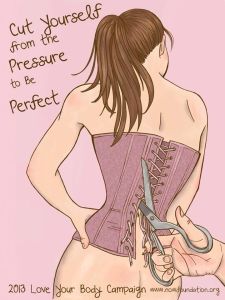
2476e248ee6b4b82e7171e594fbdc52c
Picture: Love Your Body Campaign http://www.nowfoundation.org

The body positivity movement says #effyourbeautystandards because #allwomenarebeautiful. It says – I’m choosing to love and embrace my figure, jiggly bits, weight, stretch marks, cellulite, blemishes, body hair and natural hair DESPITE what society tells me is/is not beautiful.

As someone who ABSOLUTELY adores the body positivity movement, lives by it and actively encourages friends to practice it – I’ve never really stopped to think about how much effort and time it takes to practice self-love under the model of body positivity.

To ask someone to love their perceived ‘flaws’ instantaneously can be very difficult. Not all women can just magically become body positive, especially when women are conditioned to hate themselves; when women are told that they need to look a certain in order to be happy, that they must have perfect hair, skin, eyebrows, lips, lashes, jaw structures, boobs, butts, legs, thighs and VAGINAS (YES – labiaplasty is not uncommon). Literally every damn aspect of our bodies ‘could be improved’ according to society’s standards. And on top of that women are constantly pitted against each other in this ‘who wore it better culture’ instead of ‘they both slayed culture’. IT’S EXHAUSTING.

Ashley Graham
Picture: Ashley Graham – Facebook

So, not only is it already difficult enough for women to love themselves. But – sadly – even when women do practice body positivity they can be criticised and shamed by other women. Ashley Graham built the #BeautyBeyondSize hashtag, and has championed the body positivity movement. In a Lenny Letter, she explains that while she is a curvy woman, she is criticised and shamed for going to the gym and accused of selling out when she looks skinnier. Graham says that she isn’t just representing ‘plus size’ women, she’s there for “all women who don’t feel comfortable in their skin, who need a reminder that their unique bodies are beautiful.”

The thing is, can we as a society really view our unique bodies as ‘beautiful’? Our ‘imperfections’ as beautiful? And by extension – can we learn to view our own ‘imperfections’ as beautiful? I sure hope and believe so, but I ask this because when actress and comedian, Amy Schumer posed for the Pirelli Calendar in 2016, she was called ‘brave’ rather than ‘beautiful’ for showing her body as it is. And I think that this ‘brave’ over ‘beauty’ response by people is extremely telling. It suggests that maybe we as a society have been so conditioned by what society deems is beautiful, that society is unable or unwilling to see the beauty in our ‘imperfections’, even with the body positive movement gaining significant traction. (But hey, isn’t that why we have the body positive movement – because FUCK what society thinks is beautiful).

7bf1d0b1e211b9424fdb34e087866790
Picture: Amy Schumer, Pirelli Calendar by Annie Leibovitz

Reflects momentarily

I wonder though, does the body positivity movement place too much of a focus on our physical appearance? The body positive movement may teach women that they are more than just their bodies, but does it really do that?

Lately, this idea of ‘body neutrality’ has emerged and could change the way we view our bodies. According to Christine Morgan, CEO of The Butterfly Foundation, a foundation that supports people with body image issues and eating disorders, explains that body neutrality is “changing the conversation and taking the focus off judging your body. It’s looking at your body as being an instrument that propels you through life, not one that equates you as being good or bad or successful as a person.” According to Melissa A. Fabello, body acceptance activist and Co-Managing Editor of Everyday Feminism, “body neutrality is freedom from the obsession with our bodies entirely.

According to Autumn Whitefield-Madrano, author of Face Value: The Hidden Ways Beauty Shapes Women’s Lives, “body love, beside the fact that it’s a high standard, is it’s asking women to regulate their emotions, not just their bodies”. I guess, it’s no wonder that some women who try to practice body positivity still find themselves struggling to love themselves and experience fluctuations in how they feel about their body. According to Cassie Mendoza-Jones, author of You Are Enough, body neutrality is “a feeling of acceptance of where you are in your body journey today, a way to feel comfortable in your skin without feeling as though you’re investing all your waking time and energy into eating well, exercising and thinking about your body.”

I’ll be honest, I hadn’t heard about body neutrality until recently and it immediately reminded me of writer and artist, Rupi Kaur‘s stunning quote:Rupi Kaur Quote


I really do wonder whether the body positivity movement places too much of a focus on our physical appearance. But, I think that’s the wrong question. I believe women are just trying to find happiness in their own skin and rid themselves of the hate and shame they have been conditioned to feel in this highly superficial world. Whatever means by which a woman needs to do that, is something I will support.

Arguably, body neutrality and body positivity can still co-exist. Some women may reach a point in life where they just accept who they are and are almost indifferent to the harsh beauty expectations placed upon women. Some women may feel that embracing their bodies and at the same time knowing that their bodies do not define their worth, is what gives them happiness. It’s a matter of whatever works for you. Whatever makes you feel beautiful because all women deserve to feel beautiful.

Featured Image: Instagram (Curvy Craves)

Skinny is Not a Prerequisite to Happiness

Words: Jessica Sheridan

When I was 18 I was fat. Not as fat as I am right now, but still generically fat. I had some slight issues with self esteem at the time, but nothing too terrible. Just the usual self-doubt all teenagers go through. But for the most part I could see my positive qualities when I looked in the mirror. I liked my hair. My eyes. My boobs. And my boyfriend at the time could see beauty in me too, and wasn’t bothered by my weight. I was in my first year of my dream degree, I had a good circle of friends, and I was recovering from depression. For the most part, I was happy.

Things changed when I met my boyfriend’s mother.

She had already expressed her dislike for me, despite never having met me. She wanted her son to date someone from the same cultural background as her family, which I understood to some extent. But she seemed to get over it with time and eventually asked to meet me in person. I was hopeful and dressed nicely that day. I was polite, I smiled, I even brought a gift for her. But after accepting my gift, she spoke a single phrase in Mandarin and left the room.

I don’t speak Mandarin, but anyone could have guessed something was wrong. Still, it can’t have been that bad, right? I asked my boyfriend what was wrong and he simply replied that she did not like me. How? How could she not like me? We had barely spoken before she left the room, and I didn’t think it was possible to actively dislike someone without getting to know them first. I grew more concerned the longer he refused to explain what had happened. Had I worn too much make-up? Was my gift wrong? Should I have tried to learn some Mandarin before meeting her? It wasn’t until we were outside his apartment and on our way out for lunch that he finally translated what had happened.

‘She said you’re too fat.’

I didn’t know how to respond. I’d been told I was fat before, countless times. Growing up my parents had regularly tried to pressure me into losing weight because they were worried about my health. But whenever I went to the doctor my physical health was always fine. Eventually I learned to take their comments in stride, because I knew it at least came from a place of love. And of course I had heard the occasional comment from kids during school or strangers on the street, but it never had any real consequences for me.

But this had not come from a place of love. This was not a passing comment in the heat of the moment. ‘You’re too fat.’ I knew I was fat. But I didn’t know I was too fat.

I did what a lot of 18 year olds in my position would have done: I cried my eyes out. My boyfriend told me his mother was wrong and tried to brush it off as unimportant – he didn’t care what his mother thought, so why should I? My parents and friends told me that I didn’t have to lose weight for anyone but myself – I shouldn’t let it get to me.

But it did. I became obsessed with my weight. I started hitting the gym every day for hours at a time, sometimes twice a day. I stopped eating altogether at first, but luckily I had a loving family who intervened before it became a habit. Instead I began counting every calorie, skipped entire meals if I felt bloated, refused to go to parties with friends in case I was tempted to drink or eat something unplanned. I was in my first year of a double degree but I skipped class to be at the gym. In the first month I dropped 12 kilograms.

My family was initially happy to see me losing weight, but they saw my obsession and warned me to slow down. My boyfriend didn’t mention my weight loss at all to me, until one day I asked him if he had noticed my body shrinking. He had of course, but it hadn’t changed what he thought of me. I was still me, no matter my size. Everybody who loved me continued to love me just the same. Yet there I was, entirely focused on losing weight to earn the approval of a person who had deemed me not good enough because of my size.

And I was not happy.

It took me a long time to realize that losing weight for the approval of someone else was never going to be the right way to lose weight. It was never going to make me happy because it wasn’t what I wanted. I had exerted so much energy and time and thought into making myself unhappy. Over time I learned that even if I did lose weight, she would never think I was good enough for her son, and in the end he wasn’t the one for me. But it took repeated attempts at weight loss and a lot of self criticism before I learned that I was better off losing negative people from my life than I was losing numbers from a scale.

People, especially women, are often expected to conform to what other people believe is the ideal body type. People are always commenting on our bodies, as though they are an artwork on display for critique and comment. But while we are all artworks, we aren’t on display for the approval of others. I realised that I should not be changing my body to make other people happy. The only person whose happiness should be affected by my body was me. If other people chose to judge my character on my weight then it was their problem, not mine. It was not my job to alter my artwork to make other people feel comfortable.

This was not a lesson I learned over night, and it definitely wasn’t easy to put into practice. In a lot of ways I am still learning that my weight – and my appearance generally – should only matter to me. Some people seem almost reckless in the way they choose to ostracise and bully people for the most obscure and unimportant things. But what these other people think doesn’t matter. Those that love you, and decent people all around, won’t care about your weight. They won’t care about how you look, because they know that it doesn’t define who you are. You can be a beautiful, happy, and wonderful person worthy of love and respect, and be fat.

If I am already happy not being skinny, then I don’t have to be skinny to be happy.


Featured Image: Zac Quitzau Facebook: Zac’s Doodles