Madonna Shuts Down Sexist Social Expectations on Women

Society says that once a woman becomes a wife, has kids or reaches a certain age then they are no longer allowed to express their sexuality. Women who breach this outdated social norm are slut-shamed, condemned, criticised and judged for the way they dress, act and speak.

They say ‘Is that dress really appropriate for a mom to wear? What kind of example are you setting for your daughter?’ They say ‘you’re 60, you should cover up.’ They say ‘how does he [the husband] allow his wife to dress like that let alone go out in public.’ They say ‘you’re a bad role model for young women.’ They say ‘you have no self-respect.’


madonna-2
Source- Instagram: Madonna


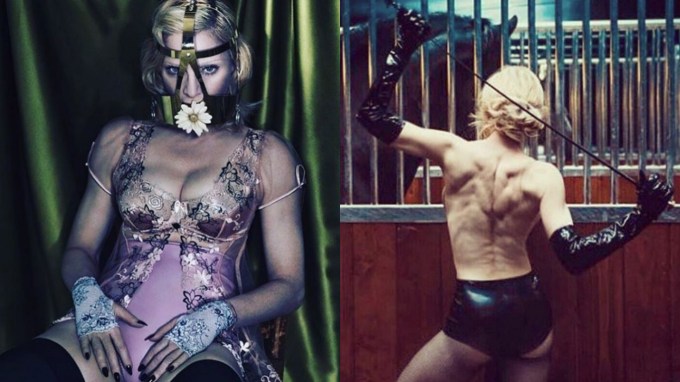
Well, the star who needs no introduction. The one and only Madonna recently posted a number of semi-nude photos onto her Instagram under the caption “Still Acting my Age!!!” accompanied by some choice words:

“How do i know I’m still acting my Age? Because its MY age and its MY life and all of you Women Hating Bigots need to sit down and try to understand why you feel the need to limit me with your fear of what you aren’t familiar with. You know what happens to Bigots? NOTHING! Nothing happens to people who. Think in a limited way. Facts… ” wrote Madonna.

Yaassss girl Yasssss!

Thank you for living your life how you want and not how society says you must. Thank you for fighting against this sexist expiry date that dictates when a woman can or cannot express their sexuality. Thank you for fighting to dismantle the sexist social expectations placed upon women.

But at a time where women need the support of other women to fight the patriarchy and these sexist social expectations- unfortunately, in many cases it’s other girls who are doing the hating. Let’s be real. Girl on girl hate exists. And it sucks.

Girl on girl hate, however unfortunate, is unsurprising. We live in a culture where girls are constantly pinned against each other as rivals. It’s always a ‘Who Wore it Better’ between two women, instead of a ‘They Both Slayed.’ As prominent novelist Chimamanda Ngozi Adichie pointed out in her personal essay We Should All Be Feminists and in Beyoncé’s song ‘Flawless’:

“We raise girls to see each other as competitors —
not for jobs or for accomplishments,
which I think can be a good thing,
but for the attention of men.
We teach girls that they cannot be sexual beings
in the way that boys are.”

So, it really is unsurprising that girl on girl hate exists. Seriously though, why does society, men and other women, think it’s okay to police what women do with their bodies? The same doesn’t happen for men, so why women?

What is it about a woman embracing herself that is so disgraceful and so difficult for society to understand? Isn’t there enough self-hate already? So many people are struggling with learning to love themselves, with body dysmorphia, eating disorders, low self-esteem and depression. Yet when a woman shows an ounce of body positivity, confidence and actually embraces herself, society is so ready to bring her down and keep her down.

Another woman who has spoken out about society trying to dictate her sexuality is Kim Kardashian West. Just one scroll through the comments on one of Kim’s photos and you can see the hate for yourself. And you’ve got to hand it to her, despite all the hate, she’s still fighting the good fight for female empowerment and women’s sexual liberation. Earlier this year, on International Women’s Day, Kim posted an essay and hit us all with some truth bombs. She wrote:

 

kim
Source- Instagram: Kim Kardashian West


“I am empowered by my sexuality. I am empowered by feeling comfortable in my skin. I am empowered by showing the world my flaws and not being afraid of what anyone is going to say about me. And I hope that through this platform I have been given, I can encourage the same empowerment for girls and women all over the world.”

How are these women bad role models? They teach young girls: that there is no shame in expressing themselves. That there is no shame in their sexuality. That they shouldn’t be ashamed of their bodies. That there is no shame in loving themselves and being confident. That they should live their lives on their terms rather than trying not to offend the delicate sensibilities of some people. That they shouldn’t be afraid of being judged by not conforming to sexist expectations of how a woman should dress, act and speak. To me, that’s the message, the fight and the resolve of a powerful role model.

If we believe in personal autonomy, then there shouldn’t be ANY limit on expressing one’s sexuality. Regardless of whether you’re a wife, mother or an older woman, ALL women should be allowed to decide on their own terms what they want to do with their bodies, free from judgement. If that means wearing a ‘burqini’ on the beach, wearing a sheer outfit or being completely covered, turtle-neck and all- Then more power to you.

So how do we change these sexist social expectations on women? Well for a start we need a lot less girl on girl hate and a lot more #GirlLove. Lilly Singh, the popular YouTuber, also known as IISuperwomanII, launched a campaign earlier this year to give the world more of what it needs #GirlLove, a campaign that is ‘Dedicated to ending and reversing the culture of girl-on-girl hatred.’ Check out her video on YouTube titled ‘Goodbye Hate, Hello #GirlLove!’

But for now, keep fighting the good fight against ‘Women Hating Bigots’ and fighting for more #GirlLove.


A Cautionary Tale of Sexual Cybercrime: The Fight to Reclaim my Name

This is a cautionary tale of my experiences as a victim of sexual cybercrime. I’m filled with fear, hesitancy and an overwhelming sense of vulnerability at the prospect of writing this piece. I’ve written a little about my experiences before but never as candid as what is to follow. This time around, I’m fighting to reclaim my name and image, a name and image that has been stolen from me and has depicted me as something I’m not.

So here goes…

It all started a couple of years ago when I discovered through a simple Google Image Reverse search that dozens of photos from my social media were plastered all over pornographic sites: xhamster.com, sex.com, cumonprintedpics.com, motherless.com, titsintops.com you name it.

But let me make one thing clear, none of my photos are or were sexually explicit, they were just ordinary images of myself, that like everyone else my age, and everyone else in today’s internet culture, would post on social media.

pic-7
Photo of me taken at age 17

It’s my understanding after years of dealing with this issue that the picture to the right is the one that started it all, or caught the attention of some pervert out there.

Somehow the perverts responsible had also managed to find out all of my details, which were also posted on these porn sites. My name, where I lived, what I studied- Some people on the thread were even trying to find out the name of my childhood best friend, so they could hack into my Facebook.

What’s more, is that on these pornographic sites were extremely explicit and highly offensive comments about myself that are to this day branded in my mind: ‘Cover her face, and I’d fuck her body,’ and ‘the amount of cum that has been spilt over her could fill a swimming pool.’ I was also called a ‘whale.’

The discovery was traumatising. I was frightened that a perpetrator would try and contact me in person. It was brutal. I immediately went to the police station, but this was before all this exposure to ‘revenge porn’ was dominating discussion in society. The police had told me that essentially there was nothing they could do, as there was nothing illegal going on, because once you upload a photo to Facebook anyone can take it and do anything they want with it, and that I had to contact the websites myself to take them down and just ensure that my social media settings were set to private.

I know now that what was happening to me is called ‘parasite porn’- the term used when ordinary images are taken from a person’s social media site and posted on threads in pornographic sites, usually alongside highly offensive, explicit and objectifying comments.

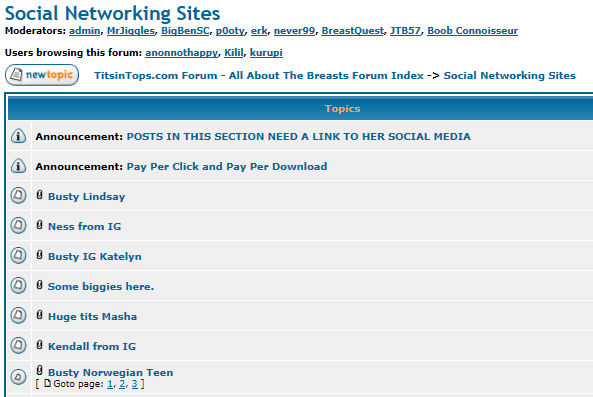
I also know that there are so many more young women who are victims of ‘parasite porn’ but haven’t a clue and all the while being preyed on by perverted men. The screenshot below is taken from just one website:

pic-3
As you can see, some young women from Instagram are being preyed upon.

For these perverted men, they might argue that what they’re doing may be questionable but technically they aren’t breaking any laws or rules. Unfortunately, they would be right. Under Facebook’s Statement of Rights and Responsibilities, ‘When you publish content or information using the Public setting, it means that you are allowing everyone, including people off of Facebook, to access and use that information, and to associate it with you.’

Perpetrators of ‘parasite porn’ might not be breaking any rules or laws right now. But it’s not far-fetched to imagine that at some point in the future, society does witness the rise in the incidence of ‘parasite porn,’ and we ask ourselves: how are we allowing this? Is it really okay for others to do anything they want with an image they find online even if it means objectifying, sexualising and preying on the victim? Is this the risk young women have to take to have an online presence? How will we deal with this issue?

So while ‘parasite porn’ might not break any rules or laws, what it does do-is open up the floodgates to an even crazier world. The world of ‘morphed porn’- where ordinary images are manipulated and superimposed on naked bodies or edited to create a more sexualised effect, and posted on porn sites.

This is where my story takes a turn for the worst…

I soon learnt that my face was being photoshopped onto naked women and I was being depicted as an adult actress. Some solo, some with other porn stars and in one image I’m being ejaculated on by two men. Today, Photoshop is so advanced that it’s really not that difficult to morph an image and make it look real- and some of mine do, which has been the cause of so many sleepless nights worrying about my future employability.

pic-888The newest morphed image is me photoshopped me onto the cover of porn film, ‘Buttman’s Big Tit Adventure Starring Noelle Martin and 38G monsters’ it says.

From the initial discovery and throughout this process, I contacted all the relevant government agencies and even the Australian Federal Police. I explained my story numerous times but I was always transferred or directed to the next agency or simply not responded to.

So I just had to take matters into my own hands. I frantically went about getting the websites removed with varying degrees of success. Luckily most sites obliged my request for deletion. Until one particular site, the site containing the ‘morphed images.’ I had sternly requested this site be deleted, but the Webmaster refused to do so unless I sent him intimate images of me. When I of course refused and demanded the page be removed, he threatened to send the photos to my university and my father. I knew better than to give into blackmail, so I held strong, but the site wasn’t deleted until much later.

Yet again, I know there are so many girls who literally don’t know about this- it’s a terrifying prospect. The screenshot to the right is from just one site.new

Now, some of you may be thinking that I should’ve just had my photo settings on private, or that I shouldn’t upload ‘risqué’ photos, or that I should just quit social media forever.

I thought the same for a long time, I was filled with shame, embarrassment and disappointment. But I’ve come to terms with the fact that I shouldn’t be ashamed at all. I haven’t done anything wrong. Like many others, I’m just another victim of sexual cybercrime.

In fact, now I would say that firstly, no matter how careful you are with your privacy settings on social media. There are always ways around it. These perverts can and do look through photos in the club taken by the club photographer, events pages and even your friends’ accounts

Secondly, blaming the victim is the easy option, especially in this culture of victim-blaming. Where victims of ‘revenge porn’ are asked why they sent nude photos in the first place, instead of why the boys posted them online. We should be asking why these perverted men aren’t being held to account for their actions and for the harm they have not only caused me, but all the other victims subjected to sexual cybercrime.

Lastly, while it may be common knowledge that the internet is a dangerous place and we should all be careful about what we put on the internet, NOBODY expects that when they upload a photo onto Instagram or Facebook, that they’ll end up being depicted as adult actress, with their name and image smeared and misrepresented in a sexually explicit and highly offensive way.

Today, the media is dominated by news of ‘revenge porn.’ We know about the harms of revenge porn to victims that they are more vulnerable to suicide, depression, emotional distress, humiliation and the list goes on.What we don’t hear are the issues of ‘parasite porn’ and ‘morphed porn,’ maybe because most of the victims don’t know they’re victims, which is terrifying enough. But an even more terrifying prospect is that you don’t need to have taken or sent a sexually explicit photo to be at risk.

If you discover that you’re also a victim of ‘parasite porn’ or ‘morphed porn,’ there’s hope still. Now, Google allows you to request the removal of certain photos and videos posted without consent from Google Search Results.

Befitting it seems, how relevant the words of Brené Brown are, the world’s most renowned researcher in shame and vulnerability:

When we deny the story, it defines us. When we own the story, we can write a brave new ending.

So here I am, reclaiming my name.


Featured Image: Zac Quitzau Facebook: Zac’s Doodles


Skinny is Not a Prerequisite to Happiness

Words: Jessica Sheridan

When I was 18 I was fat. Not as fat as I am right now, but still generically fat. I had some slight issues with self esteem at the time, but nothing too terrible. Just the usual self-doubt all teenagers go through. But for the most part I could see my positive qualities when I looked in the mirror. I liked my hair. My eyes. My boobs. And my boyfriend at the time could see beauty in me too, and wasn’t bothered by my weight. I was in my first year of my dream degree, I had a good circle of friends, and I was recovering from depression. For the most part, I was happy.

Things changed when I met my boyfriend’s mother.

She had already expressed her dislike for me, despite never having met me. She wanted her son to date someone from the same cultural background as her family, which I understood to some extent. But she seemed to get over it with time and eventually asked to meet me in person. I was hopeful and dressed nicely that day. I was polite, I smiled, I even brought a gift for her. But after accepting my gift, she spoke a single phrase in Mandarin and left the room.

I don’t speak Mandarin, but anyone could have guessed something was wrong. Still, it can’t have been that bad, right? I asked my boyfriend what was wrong and he simply replied that she did not like me. How? How could she not like me? We had barely spoken before she left the room, and I didn’t think it was possible to actively dislike someone without getting to know them first. I grew more concerned the longer he refused to explain what had happened. Had I worn too much make-up? Was my gift wrong? Should I have tried to learn some Mandarin before meeting her? It wasn’t until we were outside his apartment and on our way out for lunch that he finally translated what had happened.

‘She said you’re too fat.’

I didn’t know how to respond. I’d been told I was fat before, countless times. Growing up my parents had regularly tried to pressure me into losing weight because they were worried about my health. But whenever I went to the doctor my physical health was always fine. Eventually I learned to take their comments in stride, because I knew it at least came from a place of love. And of course I had heard the occasional comment from kids during school or strangers on the street, but it never had any real consequences for me.

But this had not come from a place of love. This was not a passing comment in the heat of the moment. ‘You’re too fat.’ I knew I was fat. But I didn’t know I was too fat.

I did what a lot of 18 year olds in my position would have done: I cried my eyes out. My boyfriend told me his mother was wrong and tried to brush it off as unimportant – he didn’t care what his mother thought, so why should I? My parents and friends told me that I didn’t have to lose weight for anyone but myself – I shouldn’t let it get to me.

But it did. I became obsessed with my weight. I started hitting the gym every day for hours at a time, sometimes twice a day. I stopped eating altogether at first, but luckily I had a loving family who intervened before it became a habit. Instead I began counting every calorie, skipped entire meals if I felt bloated, refused to go to parties with friends in case I was tempted to drink or eat something unplanned. I was in my first year of a double degree but I skipped class to be at the gym. In the first month I dropped 12 kilograms.

My family was initially happy to see me losing weight, but they saw my obsession and warned me to slow down. My boyfriend didn’t mention my weight loss at all to me, until one day I asked him if he had noticed my body shrinking. He had of course, but it hadn’t changed what he thought of me. I was still me, no matter my size. Everybody who loved me continued to love me just the same. Yet there I was, entirely focused on losing weight to earn the approval of a person who had deemed me not good enough because of my size.

And I was not happy.

It took me a long time to realize that losing weight for the approval of someone else was never going to be the right way to lose weight. It was never going to make me happy because it wasn’t what I wanted. I had exerted so much energy and time and thought into making myself unhappy. Over time I learned that even if I did lose weight, she would never think I was good enough for her son, and in the end he wasn’t the one for me. But it took repeated attempts at weight loss and a lot of self criticism before I learned that I was better off losing negative people from my life than I was losing numbers from a scale.

People, especially women, are often expected to conform to what other people believe is the ideal body type. People are always commenting on our bodies, as though they are an artwork on display for critique and comment. But while we are all artworks, we aren’t on display for the approval of others. I realised that I should not be changing my body to make other people happy. The only person whose happiness should be affected by my body was me. If other people chose to judge my character on my weight then it was their problem, not mine. It was not my job to alter my artwork to make other people feel comfortable.

This was not a lesson I learned over night, and it definitely wasn’t easy to put into practice. In a lot of ways I am still learning that my weight – and my appearance generally – should only matter to me. Some people seem almost reckless in the way they choose to ostracise and bully people for the most obscure and unimportant things. But what these other people think doesn’t matter. Those that love you, and decent people all around, won’t care about your weight. They won’t care about how you look, because they know that it doesn’t define who you are. You can be a beautiful, happy, and wonderful person worthy of love and respect, and be fat.

If I am already happy not being skinny, then I don’t have to be skinny to be happy.


Featured Image: Zac Quitzau Facebook: Zac’s Doodles

The Silhouette of Slut Shaming

She doesn’t fuck around, she’s a good girl. Ever heard that before? How about ‘look at what she’s wearing, has she no self-respect.’ What about something like, ‘I want a lady in the street, but a freak in the bed.’ Ever heard, ‘she’s elegant and classy, she’s the girl you bring home to your mum,’ or ‘leave a little to the imagination,’ or ‘if you show your legs you can’t show your cleavage, it’s one or the other.’ What about something like, ‘she fucks everyone, she must have some deep-rooted issues.’

What about, ‘she’s a filthy slut’?

All of the above are everyday examples that wreak of ‘slut shaming.’ Slut shaming refers to certain attitudes that criticise, judge and demonise females for violating traditional gender norms about women’s sexuality. It’s the deep rooted sentiment that a woman’s worth is somehow dependent on her ‘flower’ or her sexuality.

Here’s everything that’s wrong with slut shaming:

1- We’re damned if we do, we’re damned if we don’t

When a woman engages in casual sex, she’s a slut. Even if a woman just dates men, it’s assumed she’s sleeping with them, and she’s a slut. Taylor Swift, is infamously known and heavily criticised for dating many men, and she has described herself as a ‘national lightning rod for slut-shaming.’

When a woman says things of a sexual nature she’s a slut- Olivia Melville made headlines when a man posted to Facebook a screenshot of her Tinder profile which contained the rapper, Drake’s lyric, “The type of girl that will suck you dry and then eat some lunch with you,” accompanied with his caption ‘Stay classy ladies.’ Since, the incident Melville has been subject to sexual harassment.

Even when a woman says things that could be inferred as sexual, she’s a slut. When a woman dresses provocatively she’s a slut. Miley Cyrus and Kim Kardashian West to name a few, are demonised for how they choose to dress, to the point that their success and accomplishments are undermined and disregarded.

Essentially anytime a woman expresses her sexuality, she’s a slut. And yes, this is a sexist issue because there is no male equivalent. Women are sluts and men are glorified for the same actions. Slut shaming is a form of sexism and is a sexual injustice.

What’s more, is that for females who don’t necessarily violate traditional gender norms, then their femininity is called into question, they are seen as undesirable and prudish with no sexual desires. So, there’s really no way out for women. We are damned if we do, damned if we don’t.

2- Mixed expectations

The greatest irony of slut shaming is that our culture actively encourages the sexualisation of females. We live in a hypersexualised world where sex sells, yet when a woman embraces her sexuality for herself she’s a slut. So it’s okay for society to dictate how a woman should look, act, dress and behave, but it’s not okay for a woman to dictate how she lives her life. So, really, slut shaming is another way of policing how a woman should live their lives and undermines a woman’s right to personal autonomy.

3- A supposed ‘correlation’ between sex and worth

Slut shaming incorrectly assumes that the way women dress or act is reflective of their self-worth and self-respect. The thing is- women have sexual desires too! Just because a woman sleeps around doesn’t mean they have no self-respect or self-worth, they might just like  sex- it’s really as simple as that.

4- It’s us against the world

Slut shaming can occur at the hands of society, men and yes- women too. Yes- many women, and this is arguably the worst kind of slut-shaming. Women who slut shame other women reinforce this girl on girl hate, when we should be empowering other women, I mean, women already have to face it from the rest of society, we need more female solidarity.  People who have slut shamed others have lost their jobs. A Sydney man Michael Nolan, would call women sluts on Facebook, until feminist writer, Clementine Ford brought it to the public’s attention and he was subsequently fired from his job. But is the court of public opinion in bringing perpetrators of slut shaming to justice enough?  Should there be slut-shaming specific laws in Australia? What would such laws look like? Food for thought.

5- The harm is significant

To be labelled a ‘slut’ diminishes a woman’s worth, respectability, reputation, and reduces her to ‘damaged goods.’

Sadly, it is not uncommon for victims of slut shaming to take their lives because of the harm, humiliation, ridicule and harassment that comes with slut shaming. Advances in technology also make incidents of slut shaming more prevalent and easier to carry out. Revenge porn is a serious example of slut shaming, and involves the spread of sexually explicit material of usually women, typically by ex-lovers, to humiliate and degrade a girl. Victims of revenge porn can experience sexual harassment, depression, humiliation and their employability can be compromised.

6- Perpetuates broader social injustices

Slut shaming has serious social implications as it actually fuels rape culture and victim blaming. The term ‘rape culture’ brings to light how females are blamed for acts of sexual violence committed against them, because of how they dressed or how they behaved. Controversial statements from police officers and politicians have tried to justify incidents of rape by victim blaming a female’s provocative clothing or sexual promiscuity. Which makes the awareness of slut shaming even more important, because it affects a wide range of sexual injustices.

But, things are changing:

Now, luckily there is an emerging movement to reclaim the word ‘slut,’ to rid it from negative connotations and to use it as a tool of women’s sexual empowerment.  Rapper Brooke Candy in a lyric says ‘that it’s time to take the word back slut is now a compliment.’ Amber Rose, a famous player in bringing awareness to slut shaming and reducing the shame around female sexuality created the ‘Amber Rose Slut Walk.’ Furthermore, sex positivity is being encouraged by ‘The Unslut Project’ where people can openly talk about their sexual experiences, free from judgement to work against sexual bullying and slut shaming.

So, if you’re someone who believes that women should have personal autonomy and should be in control of how they live their lives, sexually promiscuous or not, without fear of condemnation and judgment, then slut shaming should be on your radar. Slut shaming affects all women.

For too long women have been told: to be afraid and ashamed of their sexuality; that the sexual woman is the unworthy bad woman. For too long, women have been told how to dress, speak and act. The silhouette of slut shaming is broad, dangerous and not a pretty sight, it is so important to be prepared to speak up if you see, hear or feel it, however trivial the circumstances.

Featured Image: Zac Quitzau. Facebook: Zac’s Doodles

The Unknowing Victims: Revenge Porn, Parasite Porn and Morphed Porn

It was 2am on a Saturday night and unlike my typical weekend of wild partying, I was enjoying a quiet night in. Little did I know that what started off as aimlessly browsing the web, would turn into an even wilder, unexpected three year ordeal that to this day is far from over. That night, my mind turned to something I heard about earlier that day, the Google Image Reverse function, that allows you to upload a picture and find out if and where it is on the Internet. So, out of pure curiosity, I decided to try it for myself. What I discovered made my body ache, like the feeling you get from hearing troubling news, but a million times worse. Dozens upon dozens of porn sites had my face featured on their pages, from xhamster to sex.com and many more.

As I opened up the sites, one at a time, I found galleries of my photos, many had been taken from my Facebook page or my friends’ Facebook pages or from nightclub albums.  My details were listed- name, age, location and what I studied. The comments that were left about me are too explicit and offensive to repeat. “Parasite Porn” is the phrase used to describe the posting of photos stolen from social media websites and repurposed for pornographic purposes.

I called the police that night and I was told to bring screenshots of the sites to the closest police station. Monday morning came and I travelled to Eastwood Police Station with my laptop in hand. There was nothing they could do.  They informed me that once a photo has been posted online anyone can use and do whatever they want with it, even if it meant misrepresenting you on porn sites. I would like to note that none of the photos I had were sexually explicit. I pleaded with the police saying that the lack of consent must make this illegal, but all I could do was to contact the sites myself and request to take them down. I have successfully taken down many sites since, but I am still in the process of removing numerous sites which feature morphed photos of me, that is, photos of me that have been manipulated into a sexually explicit nature, this is an example of “morphed pornography.”

My personal experience is not an isolated one. In a society that is dominated by a vast, under regulated Internet and social media culture, where photo sharing is a commonplace activity, many victims of this sort of cybercrime, predominantly women, find themselves vulnerable and without adequate recourse. Some victims may be able to afford the expenses to remedy the damage, such as lawyers and private investigators. But there is no remedy for the emotional damage to the spirit and dignity of these victims. All too often these crimes are occurring, from the recent celebrity nude photo scandal, where many female A-list celebrities like Jenifer Lawrence had their iCloud accounts hacked and nude photos disclosed, to the very recent incident surrounding 500 Adelaide women who were found to be victims of “revenge porn,” the public sharing of sexually explicit material, often by ex-lovers, for the purposes of humiliation.

It is easy to adopt the view that if you don’t want your photos to end up in the wrong hands, don’t upload them, or if you do upload them you should expect this kind of backlash. This very sentiment was echoed by Sunrise, when in response to the Adelaide revenge porn incident they stated “when will women learn?” not to take such photos.  The comments made by Sunrise sparked outrage when feminist writer Clementine Ford called Sunrise out for “victim-shaming,” when the in fact, these women were merely “victims of crime.”

Repairing the damage done by cybercrime can be very difficult; there are issues of jurisdiction if some websites are outside the Australian domain, not to mention the adverse effect on the victim’s employability and reputation, as she may likely become susceptible to slut-shaming. In my opinion, the most dangerous part of all, is the fact that many victims of crimes such as these, have no idea they are victims until the damage may is irreparable.

Luckily, all is not so grim. Amit Singhal, a senior vice-president of Google has announced that they would remove from their search results, nude or sexually explicit photos that were uploaded without the victim’s consent, although the photos will still appear on the original websites. Whilst Google’s course of action will not solve the issue at hand, it is a huge step in tackling this kind of cybercrime. Numerous states in the US have seen the emergence of revenge porn legislation. Australia is yet to follow suit.

Featured Image: Zac Quitzau Fb: Zac’s Doodles