The Price Women Pay for Embracing their Sexuality

I was just 10 years old when I hit puberty and I physically matured into a young woman very quickly.  I had C cups by the time I was 12 which made me the target of a lot of unwanted attention from a very early age. However, my body still hadn’t finished growing and soon I became known as the ‘girl with the big boobs’, whether I liked it or not.

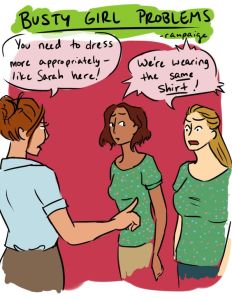
Picture: Paige ‘Rampaige’ Halsey Warren

As a young girl with a body of a grown woman, things got really awkward. During my school years I would be so embarrassed to participate in sporting activities, especially running for obvious reasons. I wouldn’t dare to get undressed in the common areas of the changing rooms, I’d wait for the next free cubicle. And clothes just didn’t fit or if they did it was because I had stretched out the material to maximum capacity. The buttons on my school dresses would constantly break free.

In my teens I became acutely aware of how I would be perceived if I wore certain clothes. Things I wore always tended to look suggestive or provocative without even trying. Even if I wanted to wear such clothes my parents wouldn’t allow it. So, the only other option was to wear clothes that made me look and feel – and I mean no offence – like a nun. My sisters have always been petite and they could wear anything – singlets, backless tops, crop tops, but for some reason they didn’t look suggestive, so it was okay for them to wear whatever they wanted.
2
Picture: Paige ‘Rampaige’ Halsey Warren

I remember how I would CRY. I would throw the worst tantrums because I was frustrated. It felt so unfair that I couldn’t wear nice clothes because I was going to be perceived as attention-seeking, slutty and promiscuous, yet my sisters could wear whatever they wanted.

As I entered my late teens, like any other girl my age, I wanted to look and feel sexy. I felt so constricted and repressed that I couldn’t wear the clothes I wanted, so I started to rebel. My parents (who are the greatest and who I love very much) were not happy. ‘Have some self-respect’, don’t look like ‘trash’, ‘cover yourself’ they would say, as if there was something inherently shameful about my body. And for a moment in time I internalised that shame, that false correlation between what one wears and their self-respect, and the view that our bodies are somehow tied to our worth.

16473291_959944767470919_991152307289219573_n
Me SLAYING – Present Day

However, it wasn’t long before I became ‘woke’ (a slang word for socially aware). I learnt about women’s sexual liberation. A movement that challenges traditional social expectations about how women should look, dress, talk and act, in relation to sexuality. And IT IS LIBERATING. IT IS EMPOWERING. TO OWN AND EMBRACE YOUR SEXUALITY. TO EXERCISE CHOICE. To rid yourself of the shame and outdated expectations that have been imposed upon women for so long.

Unfortunately, not everyone is woke. People still judge, criticise and condemn women for embracing their sexuality. What makes me so sad and quite frankly fucking angry – is that there is ALREADY so much self-hatred in this world, so many people suffer from body-image issues, low self-esteem and depression. Why are we trying to bring people down and shame women for embracing themselves, or for showing an ounce of confidence? (live and let live, love and let love). It’s freaking hard enough to love yourself in a society that constantly tells you that you’re not good enough.

However, I do believe that one should dress for the setting they are in, like in a professional setting, funeral or gym. There are appropriate clothing conventions we abide by for various reasons. But even if a woman respects dress codes where ‘appropriate’, the moment she’s caught violating ‘traditional social expectations’ which dictate how a woman should dress – some people will question her worth, credibility, value, assume things, judge and criticise her.
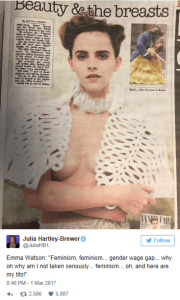
Source: Screenshot from news.com.au

Don’t believe the Western world is as dire as I’m making it out?

Well, Emma Watson’s recent photoshoot illustrates the situation. Watson, a UN Women Goodwill Ambassador and highly successful, talented actress was criticised for a ‘topless’ photo taken as part of the shoot. She was shamed, even by other women on social media. Watson, known for championing feminism, was called a hypocrite for showing her boobs. A writer for the Huffington Post described the situation PERFECTLY:

“In one simple photo, Watson has inadvertently bared a troubling truth that our society still, in 2017, cannot fathom the possibility that women can both express themselves sexually AND express a desire for equality, simultaneously” – Hannah Cranston.

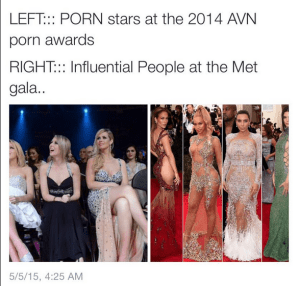
A few years ago, a similar image went viral:

As perfectly evidenced by this picture (below-right) – the price of a woman owning her sexuality means that people will try to diminish and discredit the reputation, accomplishments and character of even the most highly influential women in the world – just from her choice of attire.

Rape Culture/Victim Blaming/Slut Shaming/Image-Based Sexual Assault:
Source: Facebook

The price of a woman owning her sexuality can and does become very dangerous. Women are often victim blamed and slut shamed in cases of rape, people say ‘she shouldn’t have worn that, she was asking for it’. Women are often victim blamed and slut shamed in cases of ‘image based sexual assault’ such as revenge porn, for sending intimate images in the first place. It really seems like women are being punished for just being women.

For too long, women have been told to hide themselves, that they should feel ashamed of their sexuality. Women SHOULD NOT have to pay a price for embracing their sexuality. Let’s celebrate women reclaiming their bodies and dressing however the fuck they want, in whatever the fuck they want.


Yeah the Boys Meet Up, Third Wave Feminism Turns Up

Words: Jessica Sheridan

How many more times this year will I have to hear the same old excuse of locker room talk? For anyone who still does not understand what third-wave feminists are trying to do when we shut down sexist jokes for encouraging misogyny and rape culture, we now have another very clear example of exactly what we are talking about.

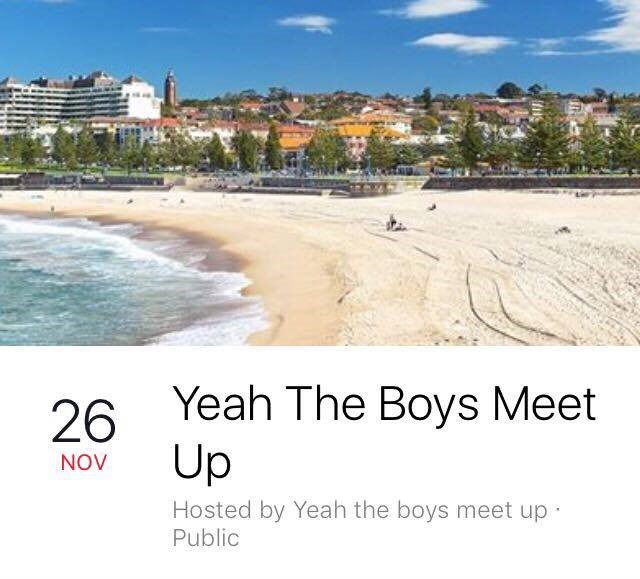
On the 4th of November an event was created on Facebook entitled ‘Yeah The Boys Meet Up’ by a page with the same name. The event seemed to have been originally intended as a meet up for fans of the popular Facebook page Yeah the Boys which has over 470,000 likes. The page posts ironic memes and status updates jesting at lad culture, and with such a following it is not unusual that the fans would band together to organise a meet up at Sydney’s own Coogee Beach.

However what probably started as a well-intended social meet-up very quickly turned toxic.

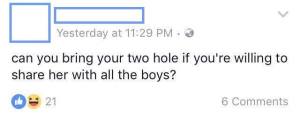
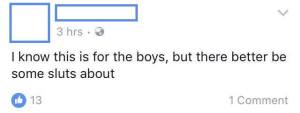
Attendees, the majority of which were young and male, began posting sexist jokes that became more and more heinous as time went by. What started as ‘just a bit of fun’ deteriorated into threatening and hateful language within a matter of days. Many posts called for physical violence against any ‘two holes’ that turned up to the gathering, while others asked if boys could bring along their ‘two hole’ to share with other boys in attendance.

In case you were wondering, ‘two hole’ was their word for women.

ddd
Screenshot from ‘Yeah The Boys Meet Up’ Facebook event

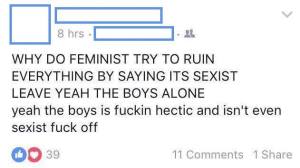
The page drew a lot of attention fast, and for all the wrong reasons. Many people – men and women alike – posted in the page asking that the event be taken down, or imploring the attendees to stop disrespecting women. This was largely met by jokes about feminists being ‘triggered’ and vulgar, sexually explicit replies whenever women tried to explain why the event was offensive. Men, and sadly some women, banded together to defend the posts on the page with aggressive and violent threats upon those that criticised the blatant misogyny within. The event, which racked up almost 10,000 attendees, had spiralled out of control, and even the Yeah the Boys Facebook page posted to disassociate themselves from the meet up. The event was eventually cancelled four days after it was originally posted.

yeah
Screenshot from ‘Yeah The Boys Meet Up’ Facebook event

You might be wondering – what the hell happened? A lot of people were left confused by the event, for all kinds of reasons. Some people didn’t understand how something which had started as joking and banter had derailed into such a sexist and hateful mess. Some didn’t think it was fair that women were angry about the event, because it was just an all-boys meet up after all – so what if girls weren’t invited? Others claimed anyone complaining about the posts on the event page just couldn’t take a joke.

But there is a very real reason why I am not laughing. There is a very real reason why it’s not funny even though I understand the joke completely.

This is rape culture.

I don’t care about the event name. Frankly, the phrase ‘Yeah the Boys Meet Up’ means nothing to me. Women are not angry that the event appeared to be for boys only; that is not the issue.

The issue is that the type of jokes and sexist banter used on the page inevitably turned into hateful, violent sexism. I say inevitable because this is a pattern we have seen time and time again. We saw it only days ago when a Melbourne law student was added to a Facebook group chat with four of her peers who were sexually and explicitly describing what they wanted to do to her. We saw it when Donald Trump tried to defend against his descriptions of sexual assault with the archaic notion of locker room talk. Time and time again we see examples of people who do not seem to understand that their jokes have gone over the line into violent sexism and misogyny.

yeah-the-boys
Screenshot from ‘Yeah The Boys Meet Up’ Facebook Event

The issue is that jokes too easily turn into threats. Banter too easily turns into sexually aggressive descriptions of what men would like to do to women. Locker room talk too easily turns into the reduction of women to their ability to sexually please men (‘two holes’) and nothing more. This is an exact example of how rape culture is perpetuated in our society. This is why third wave feminism is all about shutting down the sexist joking and the misogynistic banter. Because too easily and too often it leads to a lack of respect for women, which in turn can lead to violence against women.

It is literally that simple, and yet that terrifying.

Until women and men are equal – truly equal – in society, then sexist jokes, banter and locker-room talk will inevitably lead to a culture in which women are seen as lesser beings and objects for sexual pleasure, nothing more. This is rape culture, and this is why third wave feminism is so important.

Stop Protecting Rapists

Words: Jessica Sheridan

This morning I woke up to find yet another headline that has become all too familiar over the past few months: ‘Rapist Walks Free’. I’m starting to forget the last time I woke up and there wasn’t a similar story somewhere on my newsfeed.

A few days ago I read about Kraigen Grooms, a 19-year-old from the US who pleaded guilty to committing sexual acts with a toddler back in 2014. Grooms was 16 at the time of the attack, and the female victim was aged between 12-18 months; more of a baby than a toddler. The lewd act was also recorded on camera by another party. Police found evidence to suggest the attack was premeditated, and that Grooms may have also planned to commit a similar offence against another toddler, this time a three year old boy.

So to sum up: a teenager raped a baby while streaming it online. And he planned to do it again.

I imagine that many of us assume that an offence such as this would carry with it an appropriate sentence, and for most of us I think that a lengthy prison term would satiate our want to see justice done. Sexual violence is after all one of the most heinous crimes that can be committed, and young children and babies are some of the most vulnerable members of society. Surely, for their protection, such an act should be met with adequate justice?

Grooms, who was guilty of engaging in a lascivious act with a child, received a ten year suspended sentence. The only term he served was the two years waiting for his trial, shared between juvenile detention and county prison. The only palpable impact upon his life was the requirement that he register as a sex offender. If he fails to do so, then he will serve his prison sentence. In other words, as long as he follows the rules this time around, he doesn’t have to serve any jail time for his offence.

One can’t help but draw parallels between this case and that of the now infamous Brock Turner. Turner was found guilty of sexual assault earlier this year, and was sentenced to only six months in prison. To add salt to the wound, he only served three of those months, released early for his good behaviour. The Rolling Stone reported that the judge’s lenient sentence was supported by the claim that a lengthy prison sentence would have a ‘severe impact’ upon Turner. Turner was also required to register as a sex offender, which the judge felt was part and parcel of his punishment.

Unlike Grooms, Turner was not a minor when he committed his crimes, and his victim was 22 years old. Still it is easy to see the similar way leniency was shown in both cases. Both offenders evaded lengthy prison sentences, both are white males, and both are required to register as sex offenders. And in both cases there has been public outrage and a call for the sentencing judges to be investigated and dismissed.

But what does registering as a sexual offender really mean? In the US it limits where a sexual offender can live so that they cannot reside close to places with children, like schools and parks. However, as critic Emily Horowitz has noted, not all offenders have committed sexual crimes against children. Turner, for example, attacked an older woman. While protection of our kids is obviously paramount, you have to wonder why the focus is on children even for offenders who have not committed acts against children. The punishment does not seem to fit the crime.

Some might argue that the sex offender registry is designed to forever inhibit offenders whose details are listed publically for employers, neighbours, and basically everyone to see. But if you were hoping that this would be the long term punishment you thought they would receive, then I’m afraid you’ll be disappointed. Although the register does provide details of registered offenders, in some US states only the details of high-risk offenders are available to the public.

And as if that wasn’t enough, the Office of Justice has found no consistent studies demonstrating the effectiveness of sex offender registration in actually preventing further crime. 

So what’s the real outcome here? What punishment do Grooms and Turner face for sexually assaulting their respective victims who were both unable to defend themselves? The answer unfortunately is that neither of them will likely serve any significant prison time for their crimes, and the only long-term punishment either will receive is being listed on a glorified name and shame register.

Am I understating the impact on a person’s life of being a registered sex offender? Probably. But both of these men who committed crimes against vulnerable persons will serve understated sentences. So yes, I’m bitter. I’m angry at the sense of entitlement that seems to encourage men to take whatever they want. And I’m angry that the system is letting them largely get away with it. Why should the victim suffer more than the offender?

And yes, both Turner and Grooms will probably suffer at the hands of public outrage. And no, it is not okay to stand outside someone’s house with assault weapons as some people have done outside of Turner’s house – that is not an appropriate punishment either. None of this goes to the core of the issue: neither of these offenders will face a punishment that fits the crimes they committed.

At first we weren’t finding rapists guilty of their violent crimes. We called victims of sex crimes liars and fabricators and victim blamed our way through centuries, blindfolded and throwing punches in the dark. Now we finally accept that these violent sexual acts are occurring, but we refuse to punish offenders because we are too focused on how their lives will be affected in the long term.

We need appropriate sentencing. We need rehabilitation programs. We need justice.

Featured Image: Zac Quitzau  Facebook: Zac’s Doodles


The Silhouette of Slut Shaming

She doesn’t fuck around, she’s a good girl. Ever heard that before? How about ‘look at what she’s wearing, has she no self-respect.’ What about something like, ‘I want a lady in the street, but a freak in the bed.’ Ever heard, ‘she’s elegant and classy, she’s the girl you bring home to your mum,’ or ‘leave a little to the imagination,’ or ‘if you show your legs you can’t show your cleavage, it’s one or the other.’ What about something like, ‘she fucks everyone, she must have some deep-rooted issues.’

What about, ‘she’s a filthy slut’?

All of the above are everyday examples that wreak of ‘slut shaming.’ Slut shaming refers to certain attitudes that criticise, judge and demonise females for violating traditional gender norms about women’s sexuality. It’s the deep rooted sentiment that a woman’s worth is somehow dependent on her ‘flower’ or her sexuality.

Here’s everything that’s wrong with slut shaming:

1- We’re damned if we do, we’re damned if we don’t

When a woman engages in casual sex, she’s a slut. Even if a woman just dates men, it’s assumed she’s sleeping with them, and she’s a slut. Taylor Swift, is infamously known and heavily criticised for dating many men, and she has described herself as a ‘national lightning rod for slut-shaming.’

When a woman says things of a sexual nature she’s a slut- Olivia Melville made headlines when a man posted to Facebook a screenshot of her Tinder profile which contained the rapper, Drake’s lyric, “The type of girl that will suck you dry and then eat some lunch with you,” accompanied with his caption ‘Stay classy ladies.’ Since, the incident Melville has been subject to sexual harassment.

Even when a woman says things that could be inferred as sexual, she’s a slut. When a woman dresses provocatively she’s a slut. Miley Cyrus and Kim Kardashian West to name a few, are demonised for how they choose to dress, to the point that their success and accomplishments are undermined and disregarded.

Essentially anytime a woman expresses her sexuality, she’s a slut. And yes, this is a sexist issue because there is no male equivalent. Women are sluts and men are glorified for the same actions. Slut shaming is a form of sexism and is a sexual injustice.

What’s more, is that for females who don’t necessarily violate traditional gender norms, then their femininity is called into question, they are seen as undesirable and prudish with no sexual desires. So, there’s really no way out for women. We are damned if we do, damned if we don’t.

2- Mixed expectations

The greatest irony of slut shaming is that our culture actively encourages the sexualisation of females. We live in a hypersexualised world where sex sells, yet when a woman embraces her sexuality for herself she’s a slut. So it’s okay for society to dictate how a woman should look, act, dress and behave, but it’s not okay for a woman to dictate how she lives her life. So, really, slut shaming is another way of policing how a woman should live their lives and undermines a woman’s right to personal autonomy.

3- A supposed ‘correlation’ between sex and worth

Slut shaming incorrectly assumes that the way women dress or act is reflective of their self-worth and self-respect. The thing is- women have sexual desires too! Just because a woman sleeps around doesn’t mean they have no self-respect or self-worth, they might just like  sex- it’s really as simple as that.

4- It’s us against the world

Slut shaming can occur at the hands of society, men and yes- women too. Yes- many women, and this is arguably the worst kind of slut-shaming. Women who slut shame other women reinforce this girl on girl hate, when we should be empowering other women, I mean, women already have to face it from the rest of society, we need more female solidarity.  People who have slut shamed others have lost their jobs. A Sydney man Michael Nolan, would call women sluts on Facebook, until feminist writer, Clementine Ford brought it to the public’s attention and he was subsequently fired from his job. But is the court of public opinion in bringing perpetrators of slut shaming to justice enough?  Should there be slut-shaming specific laws in Australia? What would such laws look like? Food for thought.

5- The harm is significant

To be labelled a ‘slut’ diminishes a woman’s worth, respectability, reputation, and reduces her to ‘damaged goods.’

Sadly, it is not uncommon for victims of slut shaming to take their lives because of the harm, humiliation, ridicule and harassment that comes with slut shaming. Advances in technology also make incidents of slut shaming more prevalent and easier to carry out. Revenge porn is a serious example of slut shaming, and involves the spread of sexually explicit material of usually women, typically by ex-lovers, to humiliate and degrade a girl. Victims of revenge porn can experience sexual harassment, depression, humiliation and their employability can be compromised.

6- Perpetuates broader social injustices

Slut shaming has serious social implications as it actually fuels rape culture and victim blaming. The term ‘rape culture’ brings to light how females are blamed for acts of sexual violence committed against them, because of how they dressed or how they behaved. Controversial statements from police officers and politicians have tried to justify incidents of rape by victim blaming a female’s provocative clothing or sexual promiscuity. Which makes the awareness of slut shaming even more important, because it affects a wide range of sexual injustices.

But, things are changing:

Now, luckily there is an emerging movement to reclaim the word ‘slut,’ to rid it from negative connotations and to use it as a tool of women’s sexual empowerment.  Rapper Brooke Candy in a lyric says ‘that it’s time to take the word back slut is now a compliment.’ Amber Rose, a famous player in bringing awareness to slut shaming and reducing the shame around female sexuality created the ‘Amber Rose Slut Walk.’ Furthermore, sex positivity is being encouraged by ‘The Unslut Project’ where people can openly talk about their sexual experiences, free from judgement to work against sexual bullying and slut shaming.

So, if you’re someone who believes that women should have personal autonomy and should be in control of how they live their lives, sexually promiscuous or not, without fear of condemnation and judgment, then slut shaming should be on your radar. Slut shaming affects all women.

For too long women have been told: to be afraid and ashamed of their sexuality; that the sexual woman is the unworthy bad woman. For too long, women have been told how to dress, speak and act. The silhouette of slut shaming is broad, dangerous and not a pretty sight, it is so important to be prepared to speak up if you see, hear or feel it, however trivial the circumstances.

Featured Image: Zac Quitzau. Facebook: Zac’s Doodles